


Stigma & Substance use
What is stigma?
Stigma occurs when a person mistreats another or thinks badly about them because of a behavior, characteristic, or trait.
- Stigma can make it hard for people who need help to get the help they need, and they may refuse or stop, or even be denied treatment because of stigma.
- Stigma is harmful and can take many forms:
- Assuming a person chooses not to change their behavior.
- Considering substance use disorders (SUDs) to be a moral instead of a medical issue.
- Withholding instead of offering support or treatment based on a belief that offering support, whether social or financial, enables a person to continue using drugs.
- Lack of support for SUD training and education among employers, first responders, and healthcare professionals.
- Social rejection related to drug use or return to use.
- Not understanding the reasons behind SUDs, including a greater risk of developing an SUD based on a person’s genetic background and their personal environment, adverse childhood experiences (ACEs), or mental health conditions.
- A person’s own negative feelings about their use.
- Stereotyping—making assumptions about characteristics of whole groups of people, including people who use drugs, is a form of stigma.
Source- CDC
Points to remember about substance use and addiction
- Drug addiction is a chronic disease characterized by drug seeking and use that is compulsive, or difficult to control, despite harmful consequences.
- Brain changes that occur over time with drug use challenge an addicted person’s self-control and interfere with their ability to resist intense urges to take drugs. This is why drug addiction is also a relapsing disease.
- Relapse is the return to drug use after an attempt to stop. Relapse indicates the need for more or different treatment. It does not mean failure.
- Over time, the brain adjusts to the excess dopamine, which reduces the high that the person feels compared to the high they felt when first taking the drug—an effect known as tolerance. They might take more of the drug, trying to achieve the same dopamine high.
- No single factor can predict whether a person will become addicted to drugs. A combination of genetic, environmental, and developmental factors influences risk for addiction. The more risk factors a person has, the greater the chance that taking drugs can lead to addiction.
- Drug addiction is treatable and can be successfully managed.
- More good news is that drug use and addiction are preventable. Teachers, parents, and health care providers have crucial roles in educating young people and preventing drug use and addiction.
Source- NIDA
Words matter…
When speaking to or about someone who is experiencing a substance use disorder, words matter. Consider using these recommended terms to reduce stigma and negative bias when talking about drug use and substance use disorders.
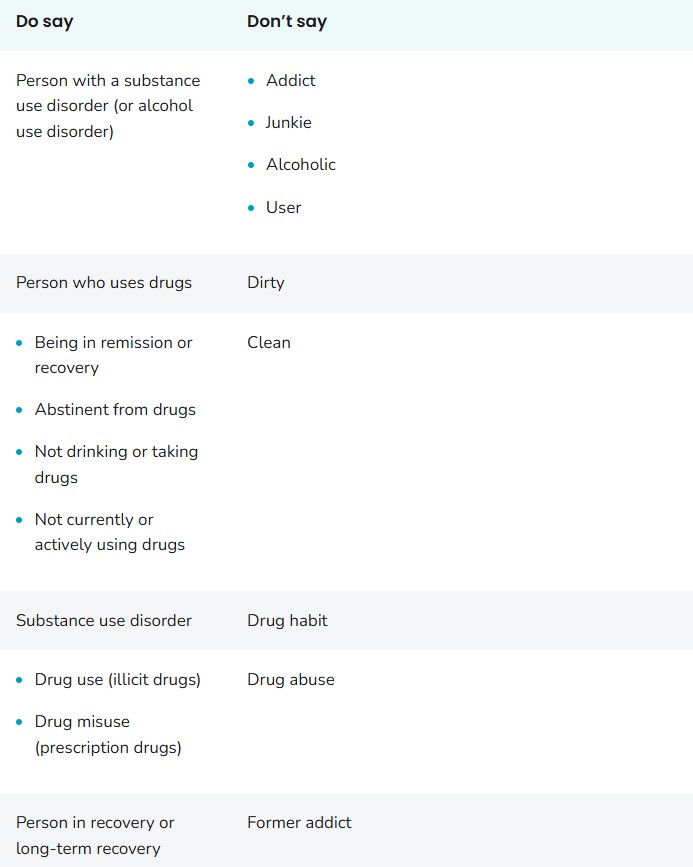
Source- CDC
For additional tips regarding preferred language for talking about addiction, click here.